CVT Transmission: Complete Guide
What Is CVT Transmission: Complete Guide
Ever wondered why some cars feel so different when you accelerate? They don’t have that usual “shift” between gears. This smooth feeling comes from technology that’s changing how vehicles deliver power to the wheels.
The idea for a continuously variable transmission originated with Leonardo da Vinci in 1490.
A CVT transmission is not like traditional automatic or manual systems. It uses variable pulleys and belts for endless gear ratios. This means power flows smoothly without interruption.
CVTs are increasingly used in cars and other vehicles, not just hybrids. More vehicles are using CVT systems now, including Ford hybrid models like the Escape Hybrid, Maverick Hybrid, and F-150 Hybrid. Why? Because they save fuel and make driving effortless.
CVTs have seen growing adoption in the auto industry since the late 1980s, with more automakers choosing this technology for its efficiency and smooth driving experience.
Knowing how CVT transmissions work helps you choose better when buying a vehicle. This guide will teach you the basics and explain how Ford has perfected this technology in their hybrid lineup.
We made this guide to help you understand vehicle technology better. By learning about CVT systems, you’ll be ready to find the right vehicle for you at Magic City Auto Group.
What is a CVT Transmission and How Does It Work
A CVT transmission is different from traditional gearboxes. Unlike other transmissions, such as manual transmissions and conventional transmissions, a CVT does not use fixed gears. Instead, it offers an endless range of gear ratios, adjusting for the best performance and fuel efficiency.
CVT systems are simple yet powerful. They let your engine run at its optimal speed, no matter your vehicle speed, by providing an infinite range of gear ratios—unlike conventional transmissions, which have fixed gear ratios. This leads to smoother acceleration, better gas mileage, and a more refined ride.
CVTs allow the engine to operate at a constant angular velocity while the vehicle moves at varying speeds.
CVTs also have fewer moving parts than traditional automatic transmissions, which can impact reliability and maintenance.
The Core Technology Behind CVTs
CVTs are called continuously variable because they change ratios smoothly. It’s like a dimmer switch, not just on or off like traditional gearboxes. This means no jarring shifts as you accelerate.
CVTs adjust the gear proportion seamlessly for any driving situation, offering limitless combinations leading to improved fuel economy and engine efficiency. Whether you’re merging onto a highway or climbing a hill, the system keeps your engine at its most efficient point. This means better fuel economy and responsive power when you need it.
The onboard computer remains in control, maintaining optimal operation for smooth power delivery. CVTs are highly efficient, transferring a significant percentage of engine power to the wheels. This efficiency helps vehicles equipped with CVT technology achieve better gas mileage than those with conventional transmissions.
Physical Components and Operation
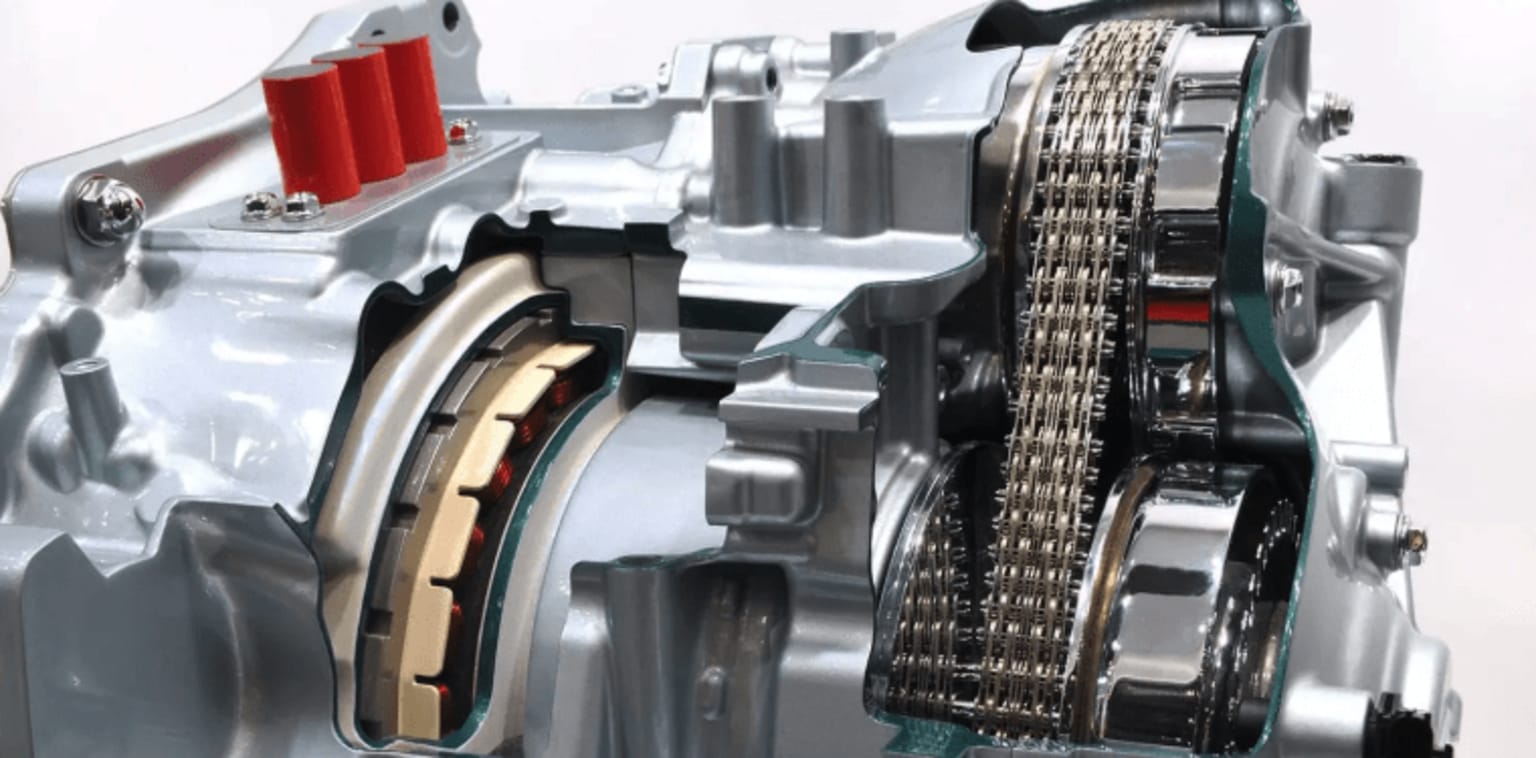
Traditional CVT transmissions use a straightforward yet clever design. The most common type, known as a belt-driven CVT, uses two pulleys—an input pulley connected to the engine and an output pulley connected to the drive wheels—linked by a belt or chain. The belt transfers power smoothly between the pulleys. Both pulleys can change their effective diameter by adjusting the distance between their two halves, allowing for different diameters and thus varying the gear ratio.
Here’s how it works:
Hydraulic pressure changes the distance between the two halves of each pulley, adjusting their effective diameter
The input pulley connects to the engine, while the output pulley connects to the drive wheels
One pulley gets a larger effective diameter while the other gets smaller, maintaining constant belt tension
The belt rides higher or lower on the pulleys based on their effective diameter, enabling belt transfers and smooth transfer of power
A computer controls the pulleys thousands of times per second
The belt or chain transfers all engine power, staying securely in place between the pulleys
Think of a CVT like a bicycle’s gears, but with endless adjustment capability. The computer adjusts the pulleys based on your driving needs. When you accelerate, it delivers the power you need while keeping the engine efficient.
This smooth operation avoids the gear hunting of traditional automatics. The CVT adjusts ratios perfectly without the need for fixed gears. This balance makes CVT technology excellent for both performance and fuel efficiency.
Benefits and Drawbacks of CVT Transmissions
Understanding CVT technology helps you choose the right vehicle. At Magic City Auto Group, we provide all the facts so you can make an informed decision. CVT transmissions offer many benefits but also have some considerations worth knowing.
Key Advantages of CVT Technology
CVT transmissions are popular for good reasons. They work differently than traditional automatics, making them ideal for everyday driving.
Superior Fuel Efficiency
CVTs are known for their exceptional fuel efficiency. By keeping your engine at the optimal engine speed for any driving situation, CVTs help reduce fuel consumption and result in better gas mileage. CVTs are also recognized for their gas efficiency, as they continuously adjust engine speed to achieve the best possible fuel economy.
CVTs can deliver 1-2 MPG better efficiency than traditional automatics. They keep the engine in its power sweet spot consistently, maximizing fuel economy throughout your drive.
Better fuel economy also means fewer emissions—good for the environment and your wallet. You’ll save money on gas over the life of your vehicle.
Seamless Acceleration and Comfort
CVTs offer a smooth ride without the usual gear shifts. This makes driving feel more refined and comfortable. You won't feel the typical jolt from gear changes.
In city driving, CVTs adapt better to changing speeds. This reduces driver fatigue, which is a significant advantage for daily commutes.
Many drivers find the smooth acceleration more pleasant. It's also better for passengers who dislike the clunk of gear changes. CVTs always select the optimal ratio for the situation, improving both comfort and performance.
Ford's eCVT Technology in Hybrid Vehicles
Ford has developed advanced eCVT systems for their hybrid lineup, including the Escape Hybrid, Maverick Hybrid, and F-150 PowerBoost Hybrid. Unlike traditional belt-driven CVTs, Ford’s eCVT uses a planetary gearset to blend power from the gasoline engine and electric motor, enhancing efficiency and durability. Ford’s Power Split transmission represents a refined approach to continuously variable technology.
How Ford's eCVT Works
Ford’s hybrid vehicles use an electronically controlled CVT, often called a “Power Split Device.” This system differs from traditional belt-driven CVTs by blending power from both the gasoline engine and electric motor for seamlessly variable ratios. In this eCVT, certain components—such as electric motors—can rotate in opposite directions within the planetary gearset, allowing the transmission to vary gear ratios smoothly and efficiently.
The eCVT in Ford hybrids is known for:
Exceptional durability and longevity
Smooth power delivery in all driving conditions
Outstanding fuel efficiency ratings
Minimal maintenance requirements
Proven reliability across hundreds of thousands of miles
Ford Hybrid Models with eCVT Technology
At Magic City Auto Group, we carry Ford hybrid models that showcase this advanced transmission technology:
Ford Escape Hybrid – Combines efficiency with versatile SUV capability and features an SUV's transmission with a CVT, which may have different maintenance requirements compared to traditional automatics
Ford Maverick Hybrid – America’s most fuel-efficient pickup truck, standard with hybrid powertrain
Ford F-150 PowerBoost Hybrid – Full-size truck capability with impressive fuel economy
These are examples of CVT equipped vehicles. Understanding the type of transmission a vehicle is equipped with is important for both maintenance and performance.
These vehicles demonstrate how Ford has perfected CVT-style technology for real-world reliability and performance.
CVT vs Traditional Automatic Transmission: Making the Right Choice
The choice between CVT and traditional automatic transmission comes down to personal preference and driving priorities. CVTs differ from standard automatic transmissions, conventional automatics, and dual clutch transmissions in several ways: while standard and conventional automatic transmissions use fixed gear sets that shift to create distinct acceleration steps, and dual clutch transmissions focus on rapid gear changes for performance, CVTs provide a seamless, stepless acceleration. Sophisticated traditional transmissions and standard automatic transmissions can have more gears—sometimes up to 10—which helps improve engine performance and fuel economy, but CVTs offer an effectively limitless number of gear ratios for better engine power and efficiency. Non-CVT transmissions and driven non-CVT transmissions provide a different driving experience, often preferred by drivers accustomed to feeling gear shifts and lower RPMs, whereas CVTs may feel unusual by holding higher RPMs for optimal efficiency. Traditional CVTs use pulleys and belts or chains to vary gear ratios, differing from eCVTs and other advanced systems that use alternative mechanisms. At Magic City Auto Group, we help you understand the differences so you can choose the right option for your lifestyle.
How They Feel Behind the Wheel
Traditional automatics feel familiar to most drivers. You’ll notice distinct shifts as you accelerate. Many find this satisfying, providing a connected driving experience. In these transmissions, engine rpms rise and fall with each gear change, and returning to reduced rpms after acceleration is common to prevent engine strain—a practice older drivers considered essential, as staying in higher rpms was a no no.
CVTs offer a unique experience. During acceleration, the engine can stay at higher rpms to maximize efficiency and power delivery, rather than returning to reduced rpms like traditional automatics. This means no shifting delays, making acceleration more efficient, but it can also produce a monotonous engine drone that some drivers dislike. CVTs typically have limited towing capacity and are not designed for high torque applications.
Drivers often describe this as a “rubber band” effect. It’s not a malfunction—it’s designed to keep the engine operating efficiently. If you’re accustomed to traditional automatics, this might feel different at first. Sports car transmissions, by contrast, are often engineered for maximum horsepower and performance, and may not use CVTs for this reason.
Visit Us Today
Understanding CVT transmissions helps you make better vehicle choices. This technology has evolved significantly, offering improved fuel efficiency, smoother acceleration, and reduced emissions.
Ford has invested heavily in perfecting their hybrid eCVT technology. The Power Split systems in Ford Escape Hybrid, Maverick Hybrid, and F-150 PowerBoost Hybrid represent some of the most reliable continuously variable systems on the market today.
Proper maintenance is key to maximizing transmission life. Maintenance intervals for CVTs may require more frequent transmission fluid changes compared to standard automatic transmissions, and using the correct transmission fluid is essential to prevent costly transmission repair work. CVTs can have higher repair costs due to their specialized design and the need for expensive fluids, and some models have a history of durability issues that can lead to a shorter lifespan compared to traditional transmissions.
At Magic City Auto Group, our car dealership’s service center is staffed with licensed CVT technicians who are best equipped for transmission repair and transmission repair work. Our service center has the specialized tools and expertise needed for all types of transmission repair. Independent stores may not have licensed CVT technicians, which can result in a higher price for repairs and less reliable service.
FAQ
What does CVT stand for and what makes it different from a regular automatic transmission?
CVT stands for continuously variable transmission (CVT). Unlike regular automatics, a continuously variable transmission (CVT) provides an infinite range of gear ratios, rather than fixed "shift points" found in traditional transmissions. This means the CVT can seamlessly and continuously adjust to any driving situation, much like a dimmer switch, for optimal engine performance and fuel efficiency.
Which Ford models feature CVT technology?
Ford uses eCVT technology in their hybrid lineup, including the Ford Escape Hybrid, Ford Maverick Hybrid, and Ford F-150 PowerBoost Hybrid. These vehicles combine the efficiency benefits of continuously variable transmission with Ford's proven reliability.
How often does CVT fluid need to be changed?
CVT fluid should typically be changed every 30,000-60,000 miles, depending on your specific vehicle and driving conditions. CVT transmission fluid is different from regular automatic transmission fluid and must be changed at the recommended intervals for optimal performance and to prevent costly repairs. This maintenance is critical for transmission longevity. Always use the manufacturer-recommended fluid type, as CVTs require specific formulations.
Are CVT transmissions better for city driving or highway driving?
CVTs excel in both environments. They're particularly well-suited for city driving because they eliminate the jerky shifting of traditional automatics in stop-and-go traffic. On highways, they maintain optimal engine RPM for fuel efficiency during steady cruising.
Can you tow with a CVT transmission?
Towing capacity varies by vehicle and powertrain configuration. The Ford F-150 PowerBoost Hybrid, which uses eCVT technology, offers impressive towing capability while maintaining hybrid efficiency. Discuss your towing needs with our team at Magic City Auto Group to find the right vehicle for your requirements.
Are CVT transmissions good for performance or sporty driving?
CVTs prioritize everyday driving comfort and fuel efficiency over aggressive performance. For drivers seeking a more engaging experience, Ford offers SelectShift automatic transmissions with Sport mode in many models. Our team at Magic City Auto Group can help match you with the right powertrain for your driving style.
Should I consider a used vehicle with a CVT transmission?
Absolutely, with the right considerations. When considering a used car, it's important to check if it's a CVT equipped car and to review its maintenance history. Verify that proper fluid changes were performed, and have our service team inspect the vehicle. Ford’s hybrid eCVT systems have proven reliable, making them solid choices in the used market.
What's the difference between a traditional CVT and Ford's hybrid transmission?
Ford’s hybrid vehicles use an eCVT or “Power Split Device,” which differs from traditional CVTs. Traditional CVTs use pulleys and belts or chains to vary gear ratios, while Ford's hybrid eCVT uses a different mechanism that electronically blends power from the gasoline engine and electric motor for smooth, seamless ratios. This system is known for outstanding reliability and efficiency.